Published Oct 28, 2026 · Updated Oct 28, 2026
What Is Trulicity? Dulaglutide Doses, Side Effects and Weight Loss
Trulicity is dulaglutide, a weekly GLP-1 shot for type 2 diabetes. Its doses, side-effect rates from the FDA label, weight change in trials, and Trulicity vs Ozempic.
Trulicity is dulaglutide, a once-weekly GLP-1 injection for type 2 diabetes made by Eli Lilly. It lowers blood sugar in adults and children aged 10 and older with type 2 diabetes, and it lowers the risk of heart attack, stroke and cardiovascular death in adults with type 2 diabetes.1 It is not approved for weight loss.1 The FDA first approved it in 2014, and the current label was revised in March 2026.1
What is Trulicity?
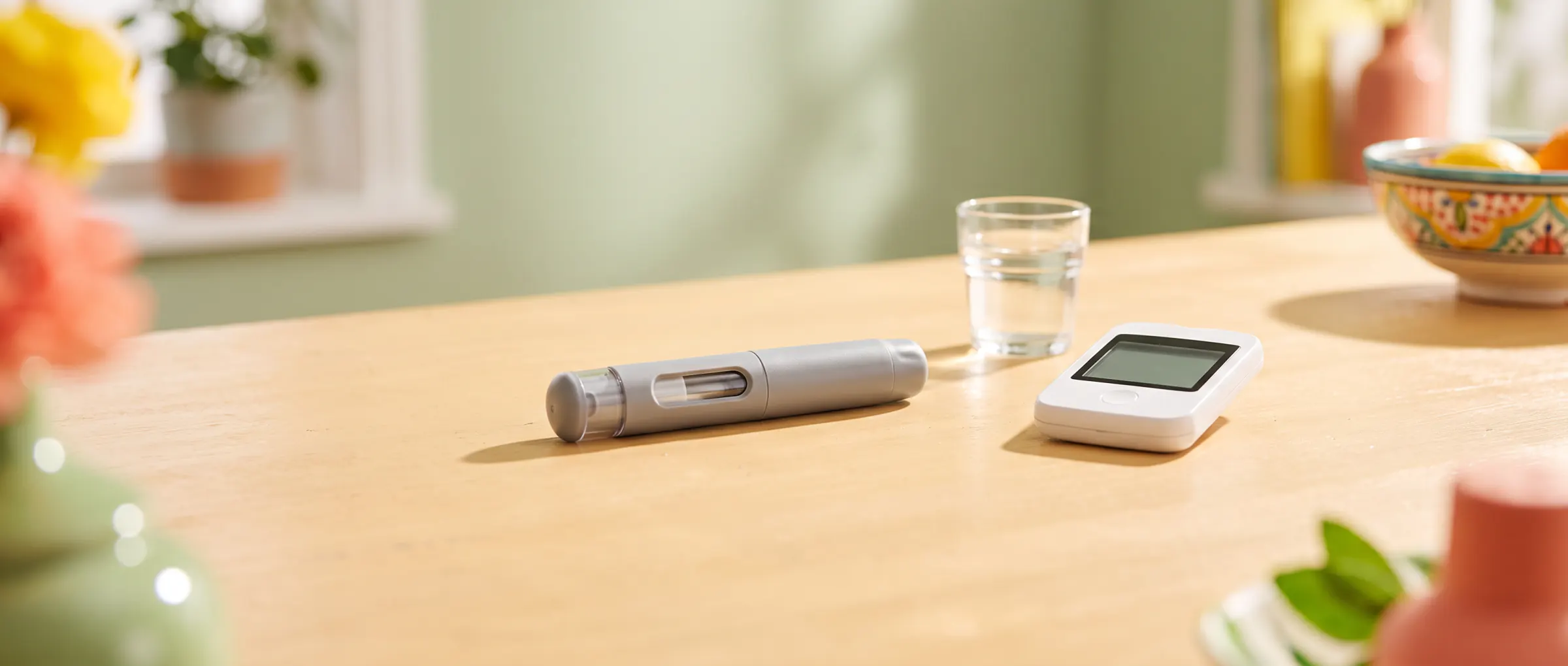
Trulicity is a prescription injection whose active drug is dulaglutide.1 You inject it under the skin once a week, at any time of day, with or without food, in the stomach, thigh or upper arm.1
The label approves it for two uses:1
- To improve blood sugar control, along with diet and exercise, in adults and children aged 10 and older with type 2 diabetes.
- To reduce the risk of major cardiovascular events (cardiovascular death, non-fatal heart attack and non-fatal stroke) in adults with type 2 diabetes who have heart disease or several heart risk factors.
It has no weight-loss indication, and its safety and effectiveness have not been established in children under 10.1 It is not insulin, and it does not replace insulin. If you take it with insulin, the two go in separate injections and are never mixed.1
Is Trulicity a GLP‑1?
Yes. Dulaglutide is a GLP-1 receptor agonist: it acts on the same receptor as the gut hormone GLP-1.1 It raises insulin release when blood sugar is high, lowers the release of glucagon, and slows the emptying of the stomach.1 Dulaglutide is a large fusion protein: a GLP-1 analog joined to part of a human antibody.1
That puts Trulicity in the same drug class as Ozempic, Wegovy, Mounjaro and Zepbound, though Mounjaro and Zepbound also act on a second receptor, GIP.7 Our guide to what a GLP-1 is explains the class.
Trulicity dose
The usual adult starting dose of Trulicity is 0.75 mg once a week.1 After 4 weeks, the dose can go up to 1.5 mg.1 If blood sugar needs more control, the dose can rise in 1.5 mg steps, after at least 4 weeks on each dose, up to a maximum of 4.5 mg a week.1 The label says the slow increase is there to cut the risk of stomach side effects.1
For children aged 10 and older, the dose starts at 0.75 mg and can go up to a maximum of 1.5 mg a week after at least 4 weeks.1
Missed a dose? Take it as soon as you can if at least 3 days (72 hours) remain before the next one. If fewer than 3 days remain, skip it and take the next dose on your usual day.1 Never take 2 doses within 3 days of each other.1
Storage. Keep the pens in the fridge at 36°F to 46°F (2°C to 8°C). Each pen can stay at room temperature up to 86°F (30°C) for a total of 14 days. Do not freeze it, and do not use a pen that has frozen.1 Our GLP-1 storage guide covers travel and heat.
Trulicity side effects
The most common side effects of Trulicity are nausea, diarrhea, vomiting, abdominal pain and decreased appetite, each in 5% or more of patients.1 They come from the label's pool of placebo-controlled trials, in which 1,670 adults took dulaglutide for an average of 23.8 weeks.1
Source: Trulicity label, Table 1.1
Any stomach or bowel side effect was reported by 32% on 0.75 mg and 41% on 1.5 mg, against 21% on placebo.1 Most were mild or moderate. Stomach side effects led 1.3% on 0.75 mg and 3.5% on 1.5 mg to stop treatment, against 0.2% on placebo.1
At the higher doses, in a 36-week trial of 1,842 adults, nausea was reported by 13.4% on 1.5 mg, 15.6% on 3 mg and 16.4% on 4.5 mg.1 In that trial, everyone started at 0.75 mg and stepped up every 4 weeks.1
The serious risks on the label. Trulicity carries a boxed warning: dulaglutide caused thyroid C-cell tumors in rats, and it is not known whether it causes them in people.1 Do not use it if you or a family member has had medullary thyroid carcinoma, or if you have MEN 2.1 The label also warns about pancreatitis, low blood sugar when it is taken with insulin or a sulfonylurea, kidney injury from dehydration, severe stomach side effects, gallbladder problems, worsening diabetic eye disease, and food in the stomach during anesthesia.1 It is not recommended for people with severe gastroparesis.1 Tell your provider before any planned procedure with anesthesia.1
If you have side effects, talk to your provider. Call them at once for severe stomach pain that does not go away, a lump or swelling in the neck, trouble swallowing, or yellowing of the skin or eyes.1
Trulicity weight loss
Trulicity is not approved for weight loss, and its trials measured weight only as a secondary result in people with type 2 diabetes.1 Weight did fall in those trials, by a few kilograms.
The biggest change on the label is from the 36-week dose trial in 1,842 adults on metformin, who started at about 95 kg. Weight fell by 3.0 kg on 1.5 mg, 3.8 kg on 3 mg and 4.6 kg on 4.5 mg (treatment-policy estimand: everyone randomized, whether or not they kept taking the drug).1 There was no placebo group in that trial.1 In the 52-week trial against sitagliptin, weight fell by 2.7 kg on 0.75 mg and 3.1 kg on 1.5 mg, against 1.5 kg on sitagliptin.1
For people who want a GLP-1 to lose weight, the FDA-approved options are Wegovy (semaglutide) and Zepbound (tirzepatide), both approved for chronic weight management in adults with obesity or with overweight plus a weight-related condition.67 Our guide to average weight loss on a GLP-1 sets out what each trial found.
Does Trulicity protect the heart?
Yes, in people with type 2 diabetes. In the REWIND trial, 9,901 adults with type 2 diabetes and heart disease or heart risk factors took Trulicity 1.5 mg or a placebo for a median of 5.4 years.2 A first heart attack, stroke or cardiovascular death occurred in 12.0% on Trulicity against 13.4% on placebo, a hazard ratio of 0.88 (95% CI 0.79 to 0.99; treatment-policy estimand).21
Most people in REWIND did not yet have heart disease: only 31.5% did.1 Deaths from any cause were 10.8% on Trulicity and 12.0% on placebo, a difference that was not statistically significant.2
Trulicity has also been the comparator for a newer drug. In SURPASS-CVOT, 13,299 adults with type 2 diabetes and heart disease took tirzepatide (Mounjaro) or Trulicity 1.5 mg.4 Heart attack, stroke or cardiovascular death occurred in 12.2% on tirzepatide against 13.1% on Trulicity, a hazard ratio of 0.92 (95.3% CI 0.83 to 1.01; treatment-policy estimand).4 Tirzepatide was no worse than Trulicity, but it was not shown to be better.4
Trulicity vs Ozempic
Trulicity and Ozempic are both weekly GLP-1 injections for type 2 diabetes, but they contain different drugs: dulaglutide and semaglutide.15 In the one head-to-head trial, SUSTAIN 7, Ozempic lowered blood sugar and weight more.3
SUSTAIN 7 randomized 1,201 adults on metformin to semaglutide 0.5 mg or 1 mg, or dulaglutide 0.75 mg or 1.5 mg, for 40 weeks.3 The results below count people while they took the drug, before any rescue medicine (on-treatment estimand).3
Source: Pratley et al., SUSTAIN 7.3 At the lower doses, A1C fell 1.5 points on semaglutide 0.5 mg against 1.1 on dulaglutide 0.75 mg, and weight fell 4.6 kg against 2.3 kg.3 The trial was funded by Novo Nordisk, the maker of Ozempic.3
SUSTAIN 7 did not test the higher doses approved since. Trulicity now goes up to 4.5 mg and Ozempic up to 2 mg a week.15
Our guide to what Ozempic is covers semaglutide in full, and Mounjaro vs Ozempic compares the two newer diabetes drugs. Switching from one GLP-1 to another is a decision for your provider.
FAQ
What is Trulicity used for? Trulicity is used to lower blood sugar in adults and children aged 10 and older with type 2 diabetes, and to lower the risk of heart attack, stroke and cardiovascular death in adults with type 2 diabetes.1
Is Trulicity insulin? No. Trulicity is a GLP-1 receptor agonist, which helps the body release its own insulin when blood sugar is high.1 It can be used with insulin, as a separate injection.1
Is Trulicity approved for weight loss? No. Its label covers only blood sugar control and heart risk in type 2 diabetes.1 Wegovy and Zepbound are the weekly GLP-1 injections approved for weight management.67
How long does a Trulicity pen last? Each pen holds one weekly dose, and a box holds 4 pens.1
What is the highest dose of Trulicity? 4.5 mg once a week for adults, reached in 1.5 mg steps after at least 4 weeks on each dose.1
Can I take Trulicity if I have had pancreatitis? Tell your provider first. The label says to stop Trulicity if pancreatitis is suspected, and the Medication Guide asks patients to report a history of pancreatitis before they start.1
This article is for information only and is not medical advice. Talk to a licensed clinician before starting, stopping or switching any GLP-1 treatment.
- 1.Trulicity (dulaglutide) injection, prescribing informationFull US prescribing information, revised 03/2026, retrieved 2026-10-28Eli Lilly and Company↩
- 2.Dulaglutide and cardiovascular outcomes in type 2 diabetes (REWIND), Gerstein HC et al.Double-blind randomized placebo-controlled trial of 9,901 adults, The Lancet 2019, PubMed recordThe Lancet↩
- 3.Semaglutide versus dulaglutide once weekly in patients with type 2 diabetes (SUSTAIN 7), Pratley RE et al.Randomized open-label phase 3b trial of 1,201 adults, Lancet Diabetes Endocrinol 2018, PubMed record, retrieved 2026-10-28The Lancet Diabetes & Endocrinology↩
- 4.Tirzepatide versus dulaglutide and cardiovascular outcomes (SURPASS-CVOT), Nicholls SJ et al.Randomized double-blind trial of 13,299 adults, NEJM 2025, PubMed recordThe New England Journal of Medicine↩
- 5.Ozempic (semaglutide) injection, prescribing informationFDA label, 2026U.S. Food and Drug Administration (Drugs@FDA)↩
- 6.Wegovy (semaglutide) prescribing informationUS prescribing information, revised June 2026Novo Nordisk↩
- 7.Zepbound (tirzepatide) prescribing informationUS prescribing information, revised August 2026Eli Lilly and Company↩
NADAC figures are pharmacy acquisition costs, not retail prices and not what you will pay. This content is educational and is not medical advice.